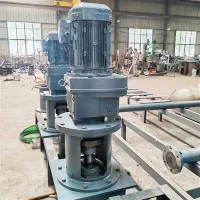
Hey there! As a supplier of Chemical Agitators, I often get asked about the minimum stirring speed of these nifty machines. It's a crucial topic, and today, I'm gonna break it down for you in a way that's easy to understand.
First off, let's talk about what a chemical agitator is. It's a device used to stir, mix, or blend different substances in a chemical process. Whether it's in a Chemical Reactor Agitator for a large - scale industrial reaction or a smaller setup, the agitator plays a vital role.
The minimum stirring speed of a chemical agitator is not a one - size - fits - all number. It depends on a bunch of factors, and I'll go through the main ones here.
Viscosity of the Fluid
The viscosity of the fluid being mixed is one of the most significant factors. Viscosity is basically a measure of a fluid's resistance to flow. Think about honey and water. Honey is much more viscous than water. When you're trying to mix a highly viscous fluid, you'll need a higher stirring speed to get proper mixing.
Let's say you're working with a thick polymer solution. This stuff is really sticky and doesn't flow easily. If you set the stirring speed too low, the agitator might not be able to break through the resistance of the fluid, and you'll end up with uneven mixing. On the other hand, if you're mixing a low - viscosity fluid like alcohol, you can get away with a lower stirring speed.
Type of Agitator
There are different types of chemical agitators, and each has its own requirements for minimum stirring speed. For example, Side Entry Mixers are designed to be installed on the side of a tank. They work well for large - volume tanks where top - entry agitators might not be practical.
Side entry mixers usually have a lower minimum stirring speed compared to some other types because they rely on the tank's shape and the flow patterns created by the mixer to distribute the mixing action. In contrast, a high - shear agitator, which is used to break down particles or emulsify substances, typically requires a higher minimum stirring speed to generate enough shear force.


Tank Size and Shape
The size and shape of the tank also matter a lot. In a small, cylindrical tank, the fluid has less distance to travel, and the agitator can create a more uniform mixing pattern at a relatively lower speed. But in a large, irregularly shaped tank, the agitator needs to work harder to reach all the corners and ensure proper mixing.
For instance, if you have a tall, narrow tank, you might need a higher stirring speed to prevent stratification, where different layers of the fluid don't mix properly. On the other hand, a short, wide tank might allow for a lower minimum stirring speed because the fluid has more space to spread out and mix.
Desired Mixing Intensity
What are you trying to achieve with the mixing? If you just need a basic blend of two substances, you might be able to get away with a lower stirring speed. But if you're looking for a high - level of homogeneity, like in a pharmaceutical process where the exact concentration of ingredients needs to be uniform throughout the batch, you'll need a higher minimum stirring speed.
Sometimes, in a fermentation process, you need to keep the microorganisms evenly distributed in the medium. This requires a carefully controlled minimum stirring speed to ensure that the organisms get enough oxygen and nutrients without being damaged by excessive shear forces.
Calculating the Minimum Stirring Speed
So, how do you calculate the minimum stirring speed? There are some empirical formulas and correlations that take into account the factors I mentioned above. For example, in laminar flow conditions (when the fluid flows in smooth layers), the power number (a dimensionless number related to the power consumption of the agitator) can be used to estimate the minimum speed.
However, these calculations can be quite complex, and it's often a good idea to use a combination of theoretical calculations and practical testing. We, as Chemical Agitator suppliers, have a lot of experience in this area. We can help you analyze your specific requirements and come up with the best - suited minimum stirring speed for your application.
Importance of Getting it Right
Getting the minimum stirring speed right is crucial for several reasons. First of all, if the speed is too low, you won't get proper mixing. This can lead to inconsistent product quality, which is a big no - no in industries like food and beverage, where taste and texture need to be the same in every batch.
Secondly, improper stirring speed can also affect the reaction kinetics in a chemical process. If the reactants aren't mixed well, the reaction might not proceed as expected, leading to lower yields or the formation of unwanted by - products.
On the other hand, if the stirring speed is too high, it can cause excessive wear and tear on the agitator and the tank. It can also consume more energy, which means higher operating costs.
How We Can Help
As a supplier of Chemical Agitators, we've got the know - how and the resources to help you determine the right minimum stirring speed for your application. We offer a wide range of agitators, from small - scale laboratory models to large - industrial - grade ones.
Our team of experts can work with you to understand your specific requirements, analyze the fluid properties, tank conditions, and mixing goals. We'll then recommend the best agitator type and the appropriate minimum stirring speed.
If you're in the market for a chemical agitator and want to learn more about how to optimize the mixing process, don't hesitate to reach out. We're here to answer your questions and help you make the right choice. Contact us today to start a discussion about your chemical agitation needs.
References
- Perry, R. H., & Green, D. W. (Eds.). (1999). Perry's Chemical Engineers' Handbook. McGraw - Hill.
- Mischke, C. R., & Shigley, J. E. (2004). Shigley's Mechanical Engineering Design. McGraw - Hill.