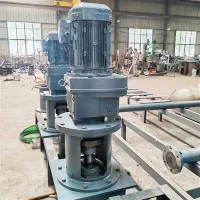
As a supplier of Top Entry Agitators, I've been gets tons of questions from customers about how to get the best mixing results. One of the most frequently asked questions is how the agitation time affects the mixing quality in a Top Entry Agitator. Today, I'll share with you what I know about this topic.
The Basics of Mixing in a Top Entry Agitator
Before we dive into the impact of agitation time, let's quickly go over how a top entry agitator works. A top entry agitator is installed at the top of a Stainless Steel Mixing Tank and its impeller rotates to create flow patterns within the liquid. This flow helps to blend different components together, whether it's chemicals in a chemical processing plant, food ingredients in a food production facility, or wastewater treatment agents in a water treatment plant.
The mixing process involves several mechanisms, including convection, diffusion, and shear. Convection is the bulk movement of the liquid caused by the rotating impeller, which helps to move the components around the tank. Diffusion is the movement of individual molecules from an area of high concentration to an area of low concentration. Shear is the force that separates and redistributes the components.
How Agitation Time Comes into Play
So, how does agitation time affect the mixing quality? Well, it's all about giving the mixing mechanisms enough time to do their job. When you start the agitator, the components in the tank begin to move and interact. At first, the mixing might be quite uneven, with pockets of high and low concentrations.
As the agitation time increases, the convection currents created by the impeller continue to circulate the liquid. This helps to break down the pockets of different concentrations and spread the components more evenly throughout the tank. Diffusion also plays a role here. Over time, the molecules have more opportunities to move and spread out, further contributing to a more homogeneous mixture.
Shear forces also work over time to break down any clumps or aggregates in the mixture. For example, in a Paddle Agitator, the paddles can apply shear force to break up solid particles or emulsify immiscible liquids. The longer the agitation time, the more opportunities the shear forces have to act on these components.
The Impact of Insufficient Agitation Time
If the agitation time is too short, the mixing quality will suffer. You might end up with a mixture that has inconsistent concentrations. For instance, in a chemical mixing process, if the reactants aren't mixed thoroughly, the chemical reaction might not proceed as expected. This could lead to reduced product quality, lower yields, or even safety hazards.
In a food processing application, insufficient agitation time could result in a product with inconsistent texture or flavor. Customers wouldn't be happy biting into a piece of cake with pockets of undissolved sugar or unevenly distributed flavorings.
In a wastewater treatment plant, if the treatment agents aren't mixed properly due to short agitation time, the water might not be treated effectively. This could lead to environmental pollution and non - compliance with regulatory standards.


The Danger of Over - Agitation
On the other hand, over - agitating the mixture can also be a problem. If you keep the agitator running for too long, you might introduce unnecessary energy consumption. The agitator consumes power to rotate the impeller, and the longer it runs, the more electricity it uses. This can significantly increase the operating costs of your mixing process.
Over - agitation can also cause damage to the components in the mixture. For example, in a mixture that contains fragile biological cells, excessive shear forces from long - term agitation can break the cells, reducing the viability of the product. In some cases, over - agitation can even cause the formation of unwanted by - products or change the physical properties of the mixture.
Finding the Optimal Agitation Time
So, how do you find the optimal agitation time for your specific application? Well, it depends on several factors. The type and viscosity of the materials being mixed are important. For example, a highly viscous liquid will take longer to mix than a low - viscosity one. The size and shape of the mixing tank also matter. A larger tank generally requires more agitation time to ensure thorough mixing.
The design of the agitator itself plays a role too. Different types of impellers, such as paddle, turbine, or propeller impellers, have different mixing efficiencies. A more efficient impeller might require less agitation time to achieve the same level of mixing quality.
One way to determine the optimal agitation time is through testing. You can start by running trials with different agitation times and analyzing the mixing quality of the samples. You can use techniques like sampling and analyzing the concentration of components at different points in the tank, or using visual inspection to check for uniformity. Once you find the agitation time that gives you the best mixing quality with the least amount of energy consumption, you can use that as a baseline for your production process.
Conclusion
In conclusion, agitation time is a crucial factor in determining the mixing quality in a top entry agitator. It's a delicate balance between giving the mixture enough time to blend properly and avoiding over - agitation. By understanding the mixing mechanisms, being aware of the potential problems of insufficient or excessive agitation, and finding the optimal agitation time for your specific application, you can achieve the best mixing results.
If you're in the market for a top entry agitator or need more advice on optimizing your mixing process, feel free to get in touch for a chat about your needs. We're here to help you find the best solutions for your mixing challenges.
References
- Perry, R. H., & Green, D. W. (1997). Perry's Chemical Engineers' Handbook (7th ed.). McGraw - Hill.
- Paul, E. L., Atiemo - Obeng, V. A., & Kresta, S. M. (2004). Handbook of Industrial Mixing: Science and Practice. Wiley - Interscience.