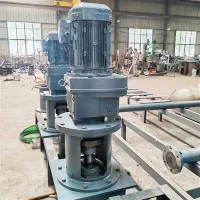
Agitators are essential equipment in various industries, playing a crucial role in mixing, blending, and homogenizing different substances. As a seasoned agitator supplier, I've had the privilege of working with a diverse range of customers from various groups. Understanding which groups agitators are commonly used in can help businesses better tailor their product offerings and marketing strategies. In this blog post, I'll explore the different types of groups that often rely on agitators and the specific needs they have.
Chemical Industry
The chemical industry is one of the largest consumers of agitators. Chemical processes often require precise mixing of reactants to ensure the quality and consistency of the final products. Agitators are used in a wide range of chemical applications, including polymerization, crystallization, and distillation.
In polymerization processes, agitators help to disperse monomers evenly throughout the reaction mixture, promoting the formation of polymers with uniform properties. For example, in the production of plastics, agitators ensure that the plastic resin is well - mixed with additives such as stabilizers and colorants. Side Entry Mixers are particularly useful in large - scale chemical reactors, as they can provide efficient mixing with minimal power consumption. You can learn more about Side Entry Mixers.
In crystallization processes, agitators are used to control the growth of crystals by promoting uniform supersaturation and preventing the formation of large, irregular crystals. This is crucial for industries such as pharmaceuticals and food, where the size and shape of crystals can affect the solubility and bioavailability of the final product.
Food and Beverage Industry
The food and beverage industry also heavily depends on agitators. From mixing ingredients in dough for bread - making to blending flavors in soft drinks, agitators are used at every stage of food production.
In the dairy industry, agitators are used to homogenize milk, ensuring that the fat globules are evenly distributed throughout the milk. This prevents the separation of cream and gives milk a consistent texture. Vertical Turbine Agitators are often used in dairy tanks due to their ability to provide high - shear mixing, which is necessary for effective homogenization. Check out Vertical Turbine Agitator for more details.


In the production of beverages, such as beer and wine, agitators are used during the fermentation process to ensure that yeast is evenly distributed throughout the liquid. This promotes consistent fermentation and helps to develop the desired flavor and aroma. Paddle Agitators are commonly used in these applications as they provide gentle mixing, which is suitable for delicate fermentation processes. You can find more information about Paddle Agitator.
Pharmaceutical Industry
The pharmaceutical industry has strict quality and safety requirements, and agitators play a vital role in meeting these standards. Agitators are used in the production of drugs, from the initial mixing of active pharmaceutical ingredients (APIs) with excipients to the final formulation of tablets, capsules, and liquid medications.
In the manufacturing of suspensions and emulsions, agitators are used to ensure that the particles are evenly dispersed in the liquid medium. This is crucial for the stability and efficacy of the pharmaceutical product. For example, in the production of eye drops, agitators are used to prevent the settling of particles, ensuring that each drop contains a consistent amount of the active ingredient.
Water and Wastewater Treatment
Water and wastewater treatment plants rely on agitators to treat water and remove contaminants. In the coagulation and flocculation processes, agitators are used to mix chemicals with water, causing suspended particles to clump together and settle out. This helps to remove impurities such as dirt, bacteria, and heavy metals from the water.
In the activated sludge process, which is commonly used in wastewater treatment, agitators are used to keep the sludge in suspension and ensure that oxygen is evenly distributed throughout the tank. This promotes the growth of beneficial bacteria, which break down organic matter in the wastewater.
Mining Industry
The mining industry uses agitators in various processes, including ore flotation and leaching. In ore flotation, agitators are used to mix the ore with chemicals and air bubbles, causing the valuable minerals to attach to the bubbles and rise to the surface for collection.
In leaching processes, agitators are used to mix the ore with a leaching agent, such as cyanide or sulfuric acid, to dissolve the valuable metals. This allows for the extraction of metals such as gold, copper, and silver from the ore.
Oil and Gas Industry
In the oil and gas industry, agitators are used in a variety of applications, including drilling mud mixing and crude oil storage. In drilling operations, agitators are used to mix drilling mud, which is a crucial fluid that helps to cool the drill bit, carry cuttings to the surface, and maintain the stability of the wellbore.
In crude oil storage tanks, agitators are used to prevent the settling of solids and the stratification of different components of the oil. This ensures that the oil remains homogeneous and can be easily transported and processed.
Conclusion
As an agitator supplier, understanding the diverse needs of different industries is essential. Each group has its own specific requirements in terms of agitation intensity, mixing efficiency, and material compatibility. By offering a wide range of agitator types, such as side - entry mixers, vertical turbine agitators, and paddle agitators, we can meet the unique needs of our customers in various industries.
If you're in need of agitators for your business, whether you're in the chemical, food and beverage, pharmaceutical, water treatment, mining, or oil and gas industry, we're here to help. Our team of experts can provide you with professional advice on the most suitable agitator for your specific application. We can also offer customized solutions to ensure that your agitation needs are met precisely. Contact us today to start a procurement discussion and find the perfect agitator for your operations.
References
- Perry, R. H., & Green, D. W. (2008). Perry's Chemical Engineers' Handbook. McGraw - Hill.
- McCabe, W. L., Smith, J. C., & Harriott, P. (2005). Unit Operations of Chemical Engineering. McGraw - Hill.
- Coulson, J. M., & Richardson, J. F. (1999). Chemical Engineering, Volume 2: Particle Technology and Separation Processes. Butterworth - Heinemann.