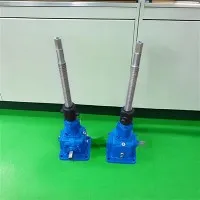
Hey there! As a supplier of helical gear reducers, I often get asked about the static performance of these nifty pieces of machinery. So, let's dive right in and break it down.
First off, what exactly is static performance? Well, in simple terms, it's all about how a helical gear reducer behaves when it's not in motion or when it's under a constant load. This includes things like its ability to handle torque, its efficiency, and its overall stability.
One of the key aspects of static performance is torque capacity. Torque is basically the force that causes an object to rotate. In the case of a helical gear reducer, it's the amount of force it can handle without breaking or experiencing excessive wear and tear. A high - torque capacity is crucial, especially in applications where heavy loads need to be moved or held in place.
Helical gear reducers are known for their excellent torque - handling capabilities. The helical design of the gears allows for a larger contact area between the teeth compared to other types of gears, like spur gears. This means that the load is distributed more evenly across the teeth, reducing the stress on each individual tooth and increasing the overall torque capacity of the reducer.
Another important factor in static performance is efficiency. Efficiency refers to how well the reducer can convert the input power into useful output power. In other words, it's a measure of how much energy is lost as heat or other forms of waste during the operation of the reducer.
Helical gear reducers are generally quite efficient. The smooth meshing of the helical teeth reduces friction, which in turn reduces energy losses. This is a big advantage, especially in applications where energy conservation is a priority. For example, in industrial settings where large amounts of power are used, a more efficient reducer can lead to significant cost savings over time.
Stability is also a critical part of static performance. A stable helical gear reducer is one that can maintain its position and alignment under load without vibrating or shifting. This is important for ensuring accurate and reliable operation.
The helical design of the gears helps to improve stability. The angled teeth of the helical gears create a thrust force that helps to keep the gears in proper alignment. Additionally, the housing and mounting of the reducer play a role in its stability. A well - designed housing can provide support and prevent excessive movement, while a proper mounting ensures that the reducer is securely attached to the equipment.
Now, let's talk about some of the factors that can affect the static performance of a helical gear reducer. One of the main factors is the quality of the materials used in its construction. High - quality materials, such as alloy steels, can provide better strength and durability, which in turn can improve the torque capacity and overall performance of the reducer.
The manufacturing process also has a significant impact. Precision machining is essential for ensuring that the gears are properly shaped and sized. Any errors in the manufacturing process can lead to uneven tooth contact, increased friction, and reduced performance.
Lubrication is another crucial factor. Proper lubrication helps to reduce friction between the gear teeth, which improves efficiency and reduces wear. It also helps to dissipate heat, which is important for maintaining the integrity of the materials.


When it comes to applications, helical gear reducers are used in a wide range of industries. In the automotive industry, they can be found in transmissions and power steering systems. In the manufacturing industry, they are used in conveyor systems, mixers, and other machinery. They are also commonly used in the food and beverage industry, where their smooth operation and high efficiency are highly valued.
If you're in the market for a helical gear reducer, you might also want to consider some related products. For example, the Planetary Gear Reducer offers a different set of advantages, such as high torque density and compact size. The Planetary Speed Reducer is also a great option for applications that require precise speed control. And if you need a combination of helical and worm gear technology, the Helical Gear Worm Gear Reducer might be the right choice for you.
In conclusion, the static performance of a helical gear reducer is a complex but important topic. Understanding the key factors, such as torque capacity, efficiency, and stability, can help you make an informed decision when choosing a reducer for your application. Whether you're looking for a reliable solution for an industrial machine or a more efficient option for a consumer product, a helical gear reducer can offer many benefits.
If you're interested in learning more about our helical gear reducers or have any questions about their static performance, don't hesitate to reach out. We're here to help you find the perfect solution for your needs. Whether it's for a small - scale project or a large - scale industrial application, we've got the expertise and the products to meet your requirements. So, let's start a conversation and see how we can work together to get the job done right.
References
- "Gear Handbook: Design, Manufacturing, and Applications" by Darle W. Dudley
- "Mechanical Design Engineering Handbook" by Mykhaylo Yashchuk