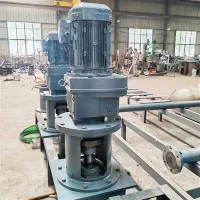
Hey there! As a supplier of Side Entry Mixers, I often get asked about the mixing uniformity these bad boys can achieve. So, let's dive right in and break it down.
First off, what the heck are Side Entry Mixers? Well, these are mixers that are installed on the side of a tank or vessel. They're super popular in industries like oil and gas, chemical processing, and wastewater treatment. You can check out more about them here: Side Entry Mixers.
Now, let's talk about mixing uniformity. In simple terms, it's all about how evenly you can distribute different components within a liquid or slurry. Imagine you're making a smoothie. You want all the fruits, veggies, and yogurt to be well - blended so that every sip tastes the same. That's the goal with industrial mixing too.
One of the key factors that affect the mixing uniformity of Side Entry Mixers is the design of the impeller. Different impeller designs can create different flow patterns within the tank. For example, a Paddle Agitator can generate a gentle, laminar flow, which is great for mixing viscous liquids or when you don't want to cause too much turbulence. On the other hand, some impellers are designed to create a more turbulent flow, which is better for quickly dispersing solids or gases in a liquid.
The number of Side Entry Mixers you use in a tank also plays a huge role. In larger tanks, using multiple mixers can help ensure that there are no dead zones where the liquid isn't being mixed properly. Each mixer can cover a specific area of the tank, and by carefully positioning them, you can achieve a more uniform mixing effect throughout the entire volume.
Another important aspect is the speed at which the mixer operates. The rotational speed of the impeller affects the shear forces and the flow velocity within the tank. If the speed is too low, the mixing might be inefficient, and there could be areas with poor dispersion. But if it's too high, it can cause excessive splashing, energy waste, and even damage to the tank or the mixer itself. So, finding the right speed is crucial for optimal mixing uniformity.
In addition to these mechanical factors, the properties of the materials being mixed also matter. The viscosity, density, and particle size of the components can all impact how well they mix. For instance, mixing a high - viscosity liquid with a low - viscosity one can be tricky. The Side Entry Mixer needs to be able to overcome the resistance of the high - viscosity fluid and ensure that it gets evenly distributed with the other component.
Let's take a look at some real - world examples. In the oil and gas industry, Side Entry Mixers are used to blend different types of crude oils or to mix additives into the oil. Achieving a high level of mixing uniformity is essential here because it can affect the quality of the final product, as well as its performance in downstream processes. If the additives aren't evenly distributed, it can lead to problems like uneven corrosion protection or inconsistent fuel properties.
In the chemical processing industry, Side Entry Mixers are often used to mix reactants in large - scale reactors. Uniform mixing is crucial for ensuring that the chemical reactions occur at the right rate and with the desired yield. Even a small deviation in the mixing uniformity can result in lower product quality or the formation of unwanted by - products.
Wastewater treatment is another area where Side Entry Mixers shine. They're used to mix chemicals like coagulants and flocculants with the wastewater to help remove impurities. A good mixing uniformity ensures that the chemicals are evenly distributed throughout the water, which improves the efficiency of the treatment process and helps in achieving better water quality.
So, how do we measure the mixing uniformity achieved by Side Entry Mixers? There are several methods. One common approach is to take samples from different locations within the tank at regular intervals and analyze their composition. By comparing the results, we can get an idea of how evenly the components are distributed. Another method is to use tracer techniques, where a small amount of a tracer substance is added to the mixture, and its distribution is monitored over time using sensors or other analytical tools.
As a supplier of Industrial Agitators, including Side Entry Mixers, we've spent a lot of time and effort in researching and developing our products to optimize mixing uniformity. We understand that every application is unique, and that's why we offer a wide range of mixer models with different impeller designs, power ratings, and speeds.


If you're in the market for Side Entry Mixers or have any questions about achieving the right mixing uniformity for your specific application, don't hesitate to reach out. We're here to help you find the best solution for your needs. Whether you're dealing with a small - scale mixing operation or a large - scale industrial process, we've got the expertise and the products to ensure that you get the most out of your mixing equipment.
In conclusion, the mixing uniformity achieved by Side Entry Mixers depends on a combination of factors, including the impeller design, the number of mixers, the operating speed, and the properties of the materials being mixed. By carefully considering these factors and choosing the right mixer for your application, you can achieve a high level of mixing uniformity, which in turn can lead to better product quality, improved process efficiency, and cost savings. So, if you're looking for a reliable Side Entry Mixer supplier, give us a chance to show you what we can do.
References
- Perry, R. H., & Green, D. W. (Eds.). (2008). Perry's Chemical Engineers' Handbook. McGraw - Hill.
- Paul, E. L., Atiemo - Obeng, V. A., & Kresta, S. M. (Eds.). (2004). Handbook of Industrial Mixing: Science and Practice. Wiley.