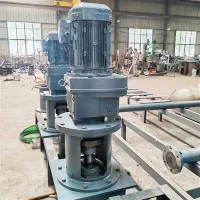
As a supplier of chemical agitators, I've seen firsthand how the Reynolds number of a fluid can have a huge impact on the performance of these machines. So, what exactly is the Reynolds number, and how does it affect chemical agitators? Let's dive in and find out.
First off, the Reynolds number is a dimensionless quantity used in fluid mechanics to predict flow patterns in different fluid flow situations. It's calculated by the formula Re = ρvd/μ, where ρ is the fluid density, v is the velocity of the fluid, d is a characteristic length (like the diameter of a pipe or the impeller in an agitator), and μ is the dynamic viscosity of the fluid. In simple terms, it helps us figure out whether the fluid flow is laminar (smooth and orderly) or turbulent (chaotic and full of eddies).
Low Reynolds Number and Its Impact
When the Reynolds number is low (usually Re < 2000), the fluid flow is laminar. In this state, the fluid moves in parallel layers with little to no mixing between them. For chemical agitators, this can present both challenges and opportunities.
In a laminar flow environment, the mixing efficiency of the agitator is significantly reduced. The lack of turbulent eddies means that the agitator has to work harder to distribute chemicals evenly throughout the fluid. Picture trying to stir honey with a small spoon – it takes a lot of effort to get the honey to move and mix, right? That's what it's like for an agitator in a low Reynolds number fluid.


However, there are some cases where laminar flow is actually desirable. For instance, in processes where shear-sensitive materials are involved, like mixing biological cultures or certain polymers, a low Reynolds number can prevent damage to these delicate substances. Our Side-entry Stirring Device can be a great choice in such scenarios. It's designed to provide gentle mixing, minimizing shear forces while still achieving a certain level of homogeneity in the fluid.
High Reynolds Number and Its Impact
On the flip side, when the Reynolds number is high (typically Re > 4000), the fluid flow becomes turbulent. Turbulence is like a whirlwind of activity in the fluid, with eddies and vortices constantly forming and breaking down. This is generally a great situation for chemical agitators.
In a turbulent flow, the mixing process is much more efficient. The eddies created by the agitator help to quickly disperse chemicals throughout the fluid, reducing the mixing time significantly. It's like using a high-powered blender to mix a smoothie – everything gets blended up in no time.
But high Reynolds number flows also come with their own set of challenges. The increased turbulence can lead to higher energy consumption for the agitator. The agitator has to work against the strong forces generated by the turbulent flow, which means more power is required to keep it running. Additionally, the high shear forces associated with turbulence can cause wear and tear on the agitator components, reducing their lifespan. Our Stainless Steel Sewage Mixer is built to handle these high-stress conditions. Its robust design and high-quality materials make it suitable for applications where high Reynolds number flows are common, such as sewage treatment plants.
Transition Zone
There's also a transition zone between laminar and turbulent flow, where the Reynolds number is between 2000 and 4000. In this zone, the flow can be unpredictable, switching between laminar and turbulent behavior. This can make it difficult to design and operate chemical agitators effectively.
For agitators operating in the transition zone, it's crucial to have a flexible design that can adapt to the changing flow conditions. Our Chemical Reactor Agitator is engineered with this in mind. It can adjust its mixing speed and pattern to ensure optimal performance, regardless of whether the flow is leaning towards laminar or turbulent.
Factors Affecting the Reynolds Number
Several factors can influence the Reynolds number of a fluid in a chemical agitation process. The viscosity of the fluid is one of the most important factors. As we mentioned earlier, more viscous fluids tend to have lower Reynolds numbers, resulting in laminar flow. Temperature can also play a role, as it affects the viscosity of the fluid. Generally, as the temperature increases, the viscosity decreases, which can increase the Reynolds number and promote turbulent flow.
The size and shape of the agitator impeller also matter. A larger impeller or one with a more aggressive design can increase the fluid velocity, thereby increasing the Reynolds number. The speed at which the agitator operates is another key factor. Faster rotation speeds typically lead to higher fluid velocities and higher Reynolds numbers.
Optimizing Agitator Performance Based on Reynolds Number
To get the most out of a chemical agitator, it's essential to consider the Reynolds number of the fluid. Here are some tips on how to optimize agitator performance based on the flow conditions:
- For low Reynolds number fluids: Choose an agitator with a design that promotes gentle mixing. Consider using multiple impellers or a larger impeller diameter to increase the mixing volume. Adjust the agitator speed to a level that provides enough agitation without causing excessive shear.
- For high Reynolds number fluids: Select an agitator with a robust construction to withstand the high shear forces. Use a variable speed drive to control the agitator speed and energy consumption. Regularly inspect and maintain the agitator components to prevent premature wear.
- For the transition zone: Opt for an agitator with a flexible design that can adapt to changing flow conditions. Monitor the flow behavior closely and make adjustments as needed.
Conclusion
In conclusion, the Reynolds number of a fluid has a profound impact on the performance of chemical agitators. Whether it's low, high, or in the transition zone, understanding the flow conditions is crucial for selecting the right agitator and optimizing its operation.
At our company, we've spent years developing and refining our chemical agitators to meet the diverse needs of our customers. Whether you're dealing with a laminar flow situation that requires gentle mixing or a high Reynolds number environment that demands high-performance agitation, we've got the right solution for you.
If you're in the market for a chemical agitator and want to discuss how the Reynolds number of your fluid might affect your choice, don't hesitate to reach out. We're here to help you find the perfect agitator for your specific application. Let's start a conversation and see how we can work together to improve your chemical processing operations.
References
- White, F. M. (2011). Fluid Mechanics. McGraw-Hill.
- Incropera, F. P., & DeWitt, D. P. (2002). Fundamentals of Heat and Mass Transfer. Wiley.