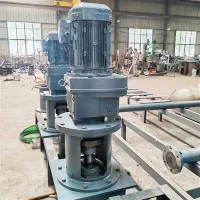
Hey there! As a supplier of Top Entry Agitators, I've seen firsthand how crucial the impeller shape is when it comes to the mixing performance of these machines. Today, I'm gonna dive deep into how different impeller shapes can impact the mixing process and why it matters for your operations.
Understanding the Basics of Top Entry Agitators
Before we get into the nitty - gritty of impeller shapes, let's quickly go over what a Top Entry Agitator is. It's a type of agitator that's mounted at the top of a tank. The main job of these agitators is to mix different substances inside the tank, whether it's a liquid - liquid, liquid - solid, or gas - liquid mixture. They're used in a whole bunch of industries, like chemical, food and beverage, and wastewater treatment.
The Role of Impellers in Mixing
Impellers are like the heart of a Top Entry Agitator. They're the parts that actually do the mixing by creating flow patterns in the tank. When the impeller rotates, it moves the fluid around, causing the different components in the mixture to blend together. The shape of the impeller determines the type of flow it creates, and that has a huge impact on the mixing performance.
Different Impeller Shapes and Their Effects
Propeller Impellers
Propeller impellers are probably the simplest and most common type. They look like the propellers on a boat. These impellers are great for creating axial flow, which means the fluid moves in a straight line from the top to the bottom of the tank or vice versa.
The main advantage of propeller impellers is that they're really efficient at high - speed mixing. They can quickly move large volumes of fluid, making them ideal for applications where you need to mix low - viscosity liquids fast. For example, in a Chemical Agitator used for diluting chemicals in a large tank, a propeller impeller can get the job done in no time.
However, they do have some limitations. Since they mainly create axial flow, they might not be the best choice for mixing highly viscous liquids or for achieving a very uniform mix in a large tank. The flow might not reach all the corners of the tank, leaving some areas with poor mixing.
Turbine Impellers
Turbine impellers come in different styles, like flat - blade, curved - blade, and pitched - blade turbines. These impellers create both radial and axial flow. Radial flow means the fluid moves outwards from the impeller towards the walls of the tank.
Flat - blade turbines are great for creating a strong radial flow. They're really effective at shearing, which is the process of breaking up large particles or droplets in a mixture. This makes them suitable for applications like emulsification in the food and beverage industry or dispersing solids in a liquid in a Chemical Reactor Agitator.
Curved - blade turbines, on the other hand, can create a more balanced combination of radial and axial flow. They're often used when you need a more uniform mixing pattern in a tank. They can reach more areas of the tank compared to propeller impellers, resulting in a better - mixed product.
Pitched - blade turbines are designed to create more axial flow compared to flat - blade turbines. They're a good compromise between propeller impellers and flat - blade turbines, offering a decent amount of both axial and radial flow.
Anchor Impellers
Anchor impellers are shaped like an anchor, with a large, slow - moving blade that runs close to the walls of the tank. They're specifically designed for mixing highly viscous liquids.
The main benefit of anchor impellers is that they can scrape the walls of the tank, preventing the build - up of solids or viscous materials on the tank walls. This is really important in industries where you're dealing with thick, sticky substances. For example, in the production of adhesives or some types of polymers, an anchor impeller can ensure that the entire mixture is well - mixed, including the parts near the tank walls.
But they're not very efficient at high - speed mixing. Since they move slowly, it takes longer to mix the contents of the tank compared to propeller or turbine impellers.
Factors to Consider When Choosing an Impeller Shape
When you're choosing an impeller shape for your Top Entry Agitator, there are a few things you need to think about.
Viscosity of the Fluid
As I mentioned earlier, the viscosity of the fluid plays a big role. If you're dealing with low - viscosity liquids, propeller or pitched - blade turbine impellers might be a good choice. For high - viscosity liquids, anchor impellers are usually the way to go.


Desired Mixing Intensity
If you need a quick, rough mix, a propeller impeller at high speed could work. But if you need a very uniform and thorough mix, you might want to consider a turbine impeller or a combination of different impellers.
Tank Size and Shape
The size and shape of the tank also matter. In a large tank, you might need an impeller that can create a wide - reaching flow pattern, like a curved - blade turbine. In a small tank, a propeller impeller might be sufficient.
Real - World Applications
Let's take a look at some real - world examples of how impeller shape affects mixing performance.
In the chemical industry, when producing paint, you need to mix pigments, solvents, and resins. A flat - blade turbine impeller is often used because it can break up the pigment particles and disperse them evenly in the liquid. This results in a high - quality paint with a uniform color and consistency.
In the food industry, for making ice cream, a combination of impellers might be used. A propeller impeller can be used at the beginning to quickly mix the basic ingredients, and then a pitched - blade turbine impeller can be used to create a more uniform texture and incorporate air into the mixture.
Conclusion
As you can see, the shape of the impeller has a profound impact on the mixing performance of a Top Entry Agitator. Choosing the right impeller shape is crucial for getting the best results in your mixing process. Whether you're in the chemical, food, or any other industry that uses agitators, understanding how impeller shape affects mixing can help you optimize your operations and save time and money.
If you're in the market for a Top Entry Agitator or need to upgrade your existing one, I'd love to help. We offer a wide range of agitators with different impeller shapes to suit your specific needs. Don't hesitate to reach out for a consultation and let's talk about how we can improve your mixing process.
References
- Perry, R. H., & Green, D. W. (Eds.). (1997). Perry's Chemical Engineers' Handbook. McGraw - Hill.
- Paul, E. L., Atiemo - Obeng, V. A., & Kresta, S. M. (2004). Handbook of Industrial Mixing: Science and Practice. John Wiley & Sons.